Synchronization Protocols Powering Continuous Group Interactions in Dynamic Web Reflex Games

Web-based reflex challenges require precise coordination among participants who engage simultaneously across distributed networks, and synchronization protocols manage state consistency while minimizing disruptions during rapid interactions. These systems handle player inputs, environmental updates, and positional data in environments where even brief inconsistencies can alter outcomes in competitive or cooperative scenarios. Observers note that protocols built on established web standards allow games to scale from small groups to larger sessions without requiring dedicated client installations.
Core Technologies Behind Real-Time State Alignment
WebSockets establish persistent bidirectional channels that transmit small packets of game state information at high frequency, whereas WebRTC extends these capabilities with peer-to-peer data channels that reduce server load during intense reflex sequences. Researchers at institutions focused on distributed systems have documented how these protocols combine to maintain frame-level synchronization even when network conditions fluctuate. Data indicates that hybrid approaches using both technologies achieve lower average latency compared to polling-based alternatives in browser environments.
State reconciliation mechanisms detect and resolve conflicts when multiple players issue near-simultaneous commands, and algorithms such as lockstep or optimistic replication adjust outcomes without halting play. Those who've examined production implementations report that predictive compensation techniques smooth visual feedback while authoritative servers validate final results, preserving fairness across varying connection qualities.
Handling Latency and Packet Loss in Group Settings
Variable network conditions present ongoing challenges for reflex-based titles, yet protocols incorporate jitter buffers and forward error correction to maintain continuity. Studies from academic sources show that adaptive bitrate adjustment for state updates helps preserve responsiveness when bandwidth decreases temporarily. In May 2026 developers continued integrating machine learning models that anticipate player trajectories and pre-send corrections, reducing perceived interruptions during fast-paced exchanges.
One case involved a European research consortium that tested synchronization layers across multiple continents, revealing measurable improvements in session retention when protocols prioritized critical reflex events over less time-sensitive data. These findings align with reports from industry bodies tracking browser gaming adoption rates in different regions.
Evolving Architectures for Expanding Player Bases
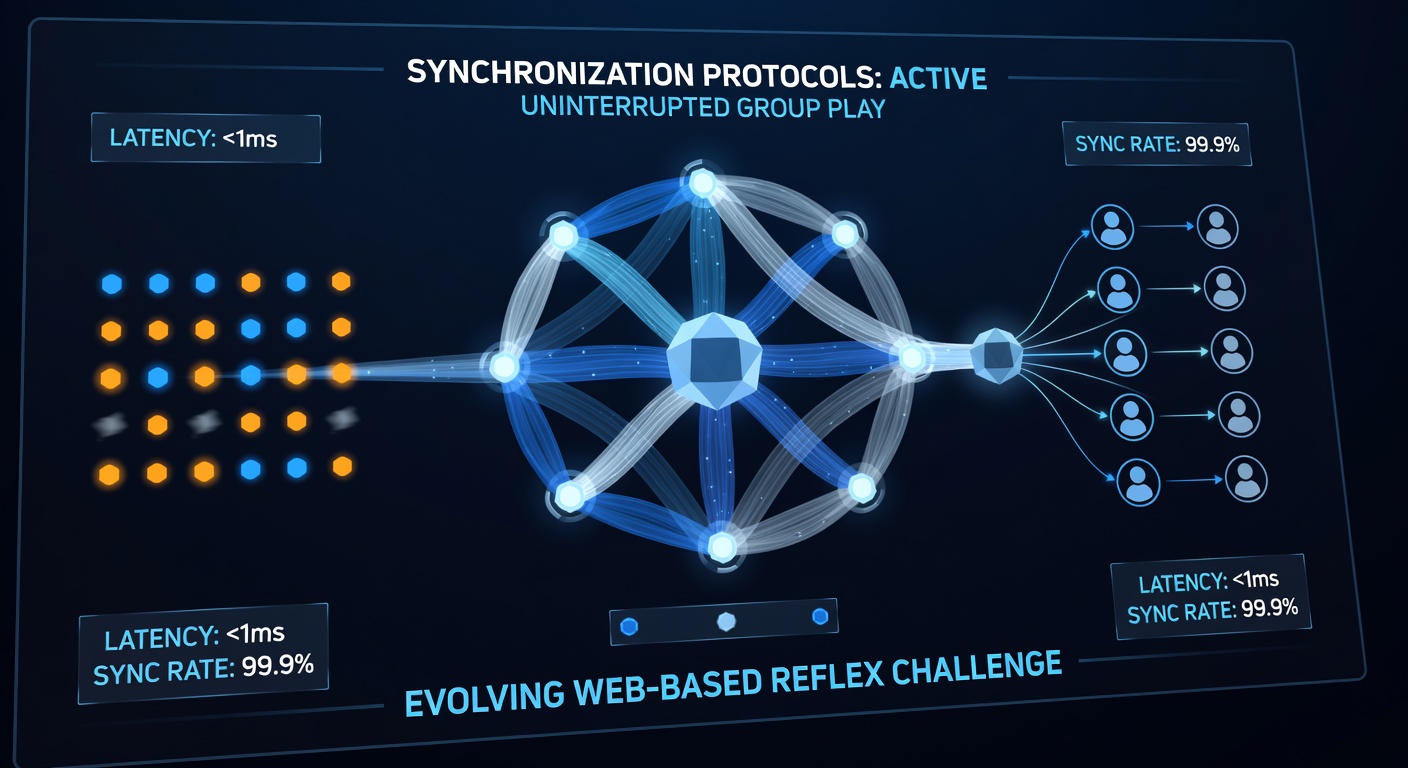
As participant numbers grow, centralized servers risk becoming bottlenecks, prompting shifts toward distributed topologies that partition game worlds into manageable shards. Each shard runs independent synchronization loops while gateways manage cross-shard interactions, and this structure supports uninterrupted play even as new players join mid-session. Experts have observed that such designs also facilitate regional matchmaking that keeps latency within acceptable bounds for reflex timing.
Security considerations integrate directly into these protocols through encrypted channels and input validation routines that prevent tampering during group exchanges. Industry reports from organizations monitoring digital entertainment note steady increases in the deployment of these layered protections alongside performance optimizations.
Integration With Emerging Web Standards
Recent updates to browser APIs have introduced more efficient scheduling for high-frequency updates, and developers leverage these to refine existing synchronization stacks without custom extensions. Data from standards organizations indicates broader compatibility across devices since the widespread implementation of WebTransport alongside established WebSocket and WebRTC stacks. This evolution supports richer reflex mechanics that incorporate physics simulations and dynamic environmental changes shared among all participants.
One study revealed that games employing these updated standards maintained stable synchronization during peak usage periods, with fewer desynchronization events recorded compared to earlier implementations. Those monitoring adoption trends point to continued refinement in protocol negotiation that automatically selects optimal transport methods based on detected network profiles.
Conclusion
Synchronization protocols continue to underpin reliable group play in browser-based reflex challenges by balancing consistency, responsiveness, and scalability through established and evolving web technologies. Ongoing research and deployment patterns as of May 2026 demonstrate measurable progress in managing the technical constraints inherent to distributed real-time environments. Further integration with advancing browser capabilities promises sustained improvements in uninterrupted multi-participant experiences across diverse network conditions.